
If you’ve ever wondered why your kid seems to make impulsive decisions or struggle to “just stop” something that’s clearly not good for them—you’re not alone. And when it comes to gambling, a lot is happening in their brains that helps explain it.
As parents, we often find ourselves frustrated when our kids don’t seem to think ahead or weigh consequences the way we do. But here’s what we’ve learned: it’s not just stubbornness or poor judgment. Their brains are literally still under construction.
The parts of the brain responsible for impulse control, decision-making, and assessing risk aren’t fully developed until the mid-20s. That means our teens and young adults are navigating a world full of instant gratification with brains that aren’t yet equipped to pump the brakes.
Now add online gambling to the mix—with its instant rewards, constant stimulation, and 24/7 access—and things can escalate quickly. These activities strongly activate the brain’s reward system, making habits form faster and making it much harder to stop. Over time, this can shape unhealthy patterns around risk, reward, and coping that follow our kids into adulthood.
How Gambling Actually Changes the Brain
Here’s something that helped us understand what our kids are up against: gambling hijacks the brain’s natural learning system.
Dopamine—that feel-good chemical—gets released when something positive happens. It’s how we learn. Think about practicing free throws: each time you get closer, your brain rewards you, reinforcing that skill. That’s dopamine doing its job.
Our brains also evolved to seek out patterns. It’s how early humans survived—recognizing weather patterns, animal behavior, and which plants were safe. Pattern recognition is basically hardwired into us.
But gambling exploits this system. There are no real patterns in randomness, but our brains keep searching for them anyway. Near-misses trigger dopamine responses, urging us to try again. Even when we know it’s random, that deeply ingrained learning mechanism keeps pushing forward.
People in recovery often describe gambling addiction as feeling no different than a drug addiction. The obsession with finding more money, the inability to think about anything else—it’s the same. That’s because gambling produces the same dopamine response in the brain as drugs do—no substances required.
And when you see brain scans side by side, it’s hard to argue otherwise.
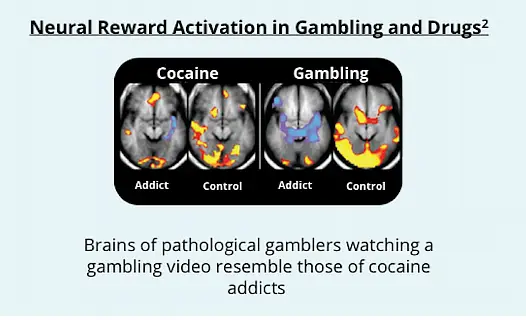
Brain scans show that pathological gamblers watching a gambling video have nearly identical neural activity to cocaine addicts. (Source: Science, “Behavioral Addictions Debut in Proposed DSM-V,” 2010).
And that’s a big part of why our kids can’t “just quit.”
These Platforms Are Built to Hook Them
Here’s the uncomfortable truth: this isn’t accidental. Online gambling platforms are intentionally designed to keep players engaged and spending.
They use welcome bonuses and “free” credits that make it feel like there’s nothing to lose. Near-miss designs make losses feel like almost wins, keeping hope alive. Personalized ads and notifications target users based on past activity, pulling them back in when they try to step away.
And fast, continuous play makes it easy to lose track of time and money before anyone realizes what’s happening.
These aren’t design flaws—they’re the business model.
The Advertising Problem Is Everywhere
Our kids are seeing gambling content constantly. Celebrities, athletes, and influencers they admire are promoting it. On YouTube, TikTok, Twitch, and Kick, they watch extreme bets, “big wins,” and flashy challenges that make gambling look exciting and completely normal.
Add in easy phone access, weak age verification, and peer pressure to “play along,” and gambling slips into everyday life—often before we even notice.
This combination of constant exposure, influencer hype, and social normalization means casual curiosity can turn into risky behavior faster than any of us would expect.
So What Do We Do with All This?
Honestly? Understanding the “why” behind our kids’ vulnerability doesn’t make it less scary—but it does help us respond with a little more clarity and a little less blame. Their brains aren’t broken. They’re just not finished yet. And the world they’re growing up in isn’t making it any easier.
The good news is that knowledge gives us a starting point. When we understand how these platforms work and why young brains are particularly susceptible, we’re better equipped to have honest conversations, set meaningful boundaries, and get help when we need it.
You’re not in this alone.
Related Resources:
Check out: Brain Connections: Understanding Addiction and the Brain
Parents Standing Together provides peer support only – not therapy, medical care, counseling, or legal advice. No professional services or treatment are offered. For any medical, legal, financial, or mental health concerns, please consult a qualified professional. If you or your child is in crisis, call 988 and seek professional help immediately.